
The Root of My Name and Why I Bend Pitches
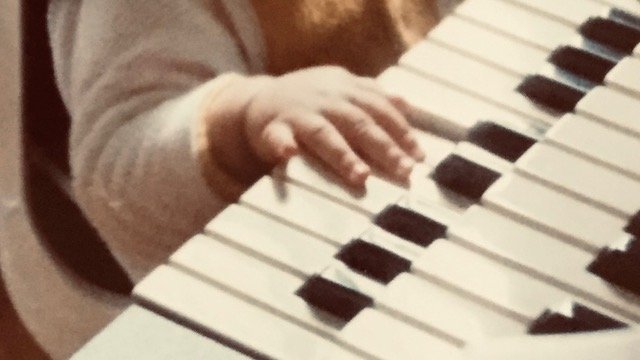
Image: Courtesy of author
The root word of my last name, Nalband, originates from Persian and means blacksmith, or someone who makes horseshoes. The 'ian' that follows, customary in Armenian surnames, roughly translates to "son of."
The first known photo of me with an instrument of any sort was taken with my father's Hammond B-3 organ in Manchester. Less than a year old, I am placed in a baby seat pushed up to the organ, my fingers splayed on the bottom keyboard, my eyes fixed on the music stand. Why did my parents spend the effort to take this photo? The organ was the first thing my father bought for our home in Manchester. Before even any furniture was the B-3. Maybe it was wishful thinking on his part then, that one day I might play that instrument.
Both of my parents grew up in Iran during the height of Shah Pahlavi’s reign and the 'White Revolution' of Iran's modernization. My father was born in Tehran in 1941, two months after Mohammad Reza Pahlavi became the Shah of Iran. I was born in Manchester in 1978, 10 months before Pahlavi was overthrown and forced into exile. My father had left Iran for the UK a couple years prior, where he met and married my mother, who had also left Tehran for Manchester. He had intended to have a family in Manchester and I was their first child. The Iran he grew up in didn't exist anymore.
Days before he would be legally allowed to claim permanent residence in the UK, he was instead given thirty days to leave the country due to his Iranian citizenship. He was forced to sell his property, his belongings, and his Hammond B-3, used for less than the two years we had our home, and we left the UK for the US. I wasn't yet two years old.
This is the landmark story of my family, one that would be relived through my father's telling over the years, and then later my own account of it to explain my background to acquaintances. But it was only when we set up home in America, in the San Fernando Valley, that I was old enough to begin to weave together the stories I was told from my family and the personal experiences I had into some sense of cultural identity. Our Persian-Armenian household was trying to assimilate to life in America in the 80's. My parents spoke both Armenian and Farsi, and often a mix of both. The lullaby my mother invented and sang to me as a child had both Armenian and Farsi in it. I didn’t know which words and phrases my parents spoke were Armenian and which were Farsi.
Our dinner table would almost always be centered around a large serving plate of basmati rice that we called plav (polo or pilaf), sometimes adorned with saffron or cooked with herbs (sabzi polo), fava beans, dill (bagahli plav), with cubed beef and tomato paste (karmir plav) or with barberries and saffron (zereshk polo). Regardless of which one my mother made, it always accompanied by a plate of tadhig, the golden buttery, crispy bottoms of the pan layered with potato or lavash. The food we ate was exclusively Persian-Armenian; dishes my mother learned to make from her mother. Chelow kebab, mounds of rice and tahdig with saffron, onions and herbs and large pots of khoresh -- Ghormeh sabzi being my favorite. You could tell what khoresh she was cooking by how the house smelled when you entered.
Discussions with my family about Tehran always felt vague, and its importance in our family history obscured by a version of Armenian nationalism rooted in victimhood with regards to the Genocide. I would come to learn that none of my grandparents had ever visited Armenia, my parents never set foot there (until my mother visited once in her fifties). As of this writing, at 47 years old, I have never been. Every diasporic Armenian I have met who has visited or lived in Armenia says they feel immediately at peace, with a deep sense of belonging. My Uncle Ruben claims to have had the best sleep of his life his first night in Yerevan. I am curious as to whether I would feel the same way. Whether seeing Mount Ararat would reduce me to tears. But I never dreamed of Yerevan. I dreamed of Tehran.
I familiarized myself with pre-Revolution Tehran, the land that my parents and grandparents are from, through our family photos. Ancestors of mine before that time were from Iran also, but not exclusively. My paternal grandfather’s family is from Nakhichevan-on-Don, Russia, even though I’ve recently learned that they originated from Iran even before then. It was my grandfather who brought our lineage back to Iran while fleeing his home after the Russian revolution. Embedded in that mysterious story is the one that connects our family tree with that of the writer and poet Mikayel Nalbandian, whose poem "The Song of an Italian Girl" was adopted into the Armenian national anthem, "Mer Hayrenik," in 1918. The rest of my family line is so shrouded in mystery, conflicting stories, and inconclusive artifacts that any declarations I may make are prone to be erroneous. The photos of my family in Iran were real however and didn’t feel distant at all, even though they were taken decades earlier in most cases and a world away from LA. They felt deeply intimate and immediate. I felt my family in them.
II.
My maternal grandfather Vigen brought Tehran to us. Having lost my grandmother Payleek a few years earlier, he fled Iran in the mid-80's and came to live with us in Los Angeles before moving into his own apartment a few years later.
My grandfather played the mandolin and piano. An electrical engineer by trade, he also wrote poetry, was interested in cinema, read voraciously about science and history and played the piano. His piano playing was often improvised, heavily arpeggiated, full of tremolos and deeply rustic. It was only until very recently that I heard the unmistakable influence of the Persian-tuned piano on his playing. I was listening to the music of Morteza Mahjubi, who was born 20 years before my grandfather. In Mahjubi's music I heard familiar motifs, phrasing, and techniques. What was most startling wasn’t how much the recordings sounded like Vigen's playing, it was how much they felt like mine.
In Mahjubi's music, I hear the bending of pitches, which I can hear from when my grandfather would play out-of-tune pianos. Instead of shying from these clashes of tonality, he would use them in his playing, embellishing them, drawing them out. Thelonious Monk could bend pitches on a tempered piano. I am always trying to also, and have over time developed my own technique that allows me to. I've been told that my playing and compositions feel at times Armenian, West Asian, Balkan. Perhaps it is because I hear folk music in the way I feel the folk and mythological tradition in the cinema of Sergei Parajanov. It doesn’t feel limited to Armenia but broad enough to encompass West Asia, the Caucasus and North Africa. In bending the pitches of the piano, I used to think I was trying to do what Monk did but this recent encounter with Mahjubi's music made me wonder if what I'm trying to achieve are the microtones I remember from Vigen. I heard openness in Vigen's sound, both in its source and its musical outcome.
Vigen was directly connected to Tehran, having lived most of his life there, and I know he and my grandmother held a broad understanding of the region. I could feel it in how he was. He was not of America, he was connected to West Asia and my strongest connection to the region. My brother Ara and I spent plenty of time with him as he became our de facto babysitter. Upon his arrival, Vigen became the closest male figure I had besides my father. They shared many of the same values, supreme dignity and suspicious optimism of the US. Where they differed was that Vigen wore his softness on his exterior whereas my father buried it deep. You could hear it in the way they played the piano; my father would explore finding melodies in a controlled way, while Vigen was open and expansive with his playing, full of ornamentations and flourishes. My father played with single note melodies, very direct and without pretense. Vigen's playing was about the performance.
III.
I taught myself to play the piano at twelve years old, to specifically play jazz for no other reason than to impress my father, whose approval I've always chased. I wanted him to respond to me the way he did when he listened to Tony Bennett and Frank Sinatra on our home stereo. His eye would glisten and I could see the goosebumps on his arms as he played their albums, recalling his memories of hearing those songs for the first time in his youth. I wanted him to react to me in the same way. I would spend hours learning standards, including the lyrics and verses as a gateway to jazz; trying to understand music theory, chord progressions. I would stay awake until the wee hours of the morning, hiding under my comforter to practice fingerings on my mattress, my imaginary keyboard. It wasn't until my father saw my dedication that he managed to get a used piano from a church sale to encourage me.
My father was the only man. He was masculine, charming, uncompromising, controlling, demanding. Naturally, I came to know other men growing up, but he was the only man I saw. Before I was born, he was a celebrated civil engineer. His own father had left Russia for Iran during the Russian revolution and was forced to raise his family in poverty. My father ascended from poverty, by excelling in his studies to reach the heights of affluent society in Tehran. These stories are the stuff of legend and have been told to me by many people who were there to witness. What I would witness was the career turn my father would make after his time as a civil engineer, a career that was sacrificed as he was forced to immigrate not once, but twice. In short, my father gave up his engineering career and rotated through unrelated jobs to make ends meet for our family. He was never defined by his work. He always carried himself with extreme dignity, and was completely, devastatingly unapologetic.
My father loved music but because he wasn’t a professional musician, I didn’t think I could learn anything from him. You must understand, my father's persona was so large that his dissatisfaction with me, how I sounded or touched the keys sometimes made me feel like he taught me, although we rarely shared time on the piano. He owned that Hammond B-3 when we lived in Manchester because that was the same instrument his hero Jimmy Smith played. My father would invent songs on the organ, but I never associated his improvisations with what I would end up doing one day. When he referred to the syncopation in jazz, he referred to them as delays, specifically the way Jimmy Smith played. That is how I understood jazz rhythm to be; delayed.
Even though it first started as a way to garner my father's affection, it was the sound of the music and the exhilaration of improvising that made me truly fall in love with jazz. Jazz felt like freedom, and my way of negotiating the unknown. My father's taste was firmly rooted in Jimmy Smith and Frank Sinatra. Mine included the likes of Thelonious Monk, Miles Davis, Ornette Coleman and John Coltrane, music that he wasn't really into.
Because my teenage years were spent in Fresno, CA at the time, and jazz musicians never really came to Fresno, I obsessively sought out every book on music from the library, and in order to hear the classic albums of jazz history, I would secretly save the lunch money my mother gave me to buy a CD at the end of every week. That was the only way I had to hear the music and it was non-negotiable to listen to everything possible. Just when I thought I had heard every album worth listening to, I would read about another one that I had to hunt down. I listened to plenty of jazz by the time I was fifteen, but it was hearing a recording of Thelonious Monk playing 'Memories of You' that convinced me this was the type of music I was born to create.
The amount of work and grit it takes to play jazz is extraordinary. The most advanced understanding of music theory only gets you so far and the technical prowess on your instrument is also just a fraction of what you need to play jazz. You will spend a lifetime working on your sound, your "feel," how you "swing," to play the blues, to learn thousands of standards in all 12 keys, you will transcribe the solos of the greatest musicians, you will learn to play in excruciatingly slow and unbelievably fast tempos. You must be able to improvise within all of these frameworks and more, paying homage to the tradition of the music while also forging ahead with new ideas. There is a pantheon of esoteric and intangible aspects to playing jazz that only increase the more you learn. Because much of the energy that creates this music is one of competition, few will teach you what you need to know. This aspect has been glorified into the mythology of jazz, propagated by many of the musicians who use it to gate-keep access and acceptance. The stories that were told by many of the musicians I looked up to as a young musician revolved not around camaraderie and dedication but around the lore of musicians getting kicked off the bandstand for not being able to play, this or that "cat" getting their "teeth cut" because they couldn't keep up with the velocity or harmonies of the music during jam sessions. This outsized masculine bravado that musicians wore turned art into sport, masking the fragile egos all in search of the same recognition as the masters. Much of why people pursue jazz isn't about the sound of the music, it was about what the music looked like and the unbelievably difficult barrier to entry.
I was still working hard to become a jazz musician as I entered college. I was listening to classic Blue Note albums, very much still using what money I had to buy records instead of meals. I began to meet and learn from some of my heroes like McCoy Tyner, Billy Higgins, Jackie McLean, Horace Silver, Art Farmer and John Hicks. It was like my record collection was coming to life. I was the awkward young man witnessing the conversations between these giants, soon spending hours with them, badgering them with questions, and learning through stories of their first hand experiences. The more time I spent chasing my heroes, learning what I could from them, and trying to act the jazz musician, the less time I spent with either my grandfather or my father. The trials and tribulations of impressing my father was replaced by the pursuit of attention from my music heroes. I became preoccupied with their approval and acceptance.
John Hicks was the one who invested the most time on me. We spent time at the piano together, hours after his shows in his hotel room drinking red wine, he told me stories of Lee Morgan, Art Blakey, Miles Davis, Bud Powell and Sonny Clark among many others. Jazz was no longer feeling relegated to history books and records, but a living history, with real people. Because of his range, John Hicks' music spanned the history and diversity of jazz. He not only recorded his own compositions but the music of Earl Hines and Mary Lou Williams as well as playing in the bands of Art Blakey, Betty Carter, and Pharaoh Sanders. Learning the history of this music is as important as learning the music itself. To know jazz is to know it is black American music that was born out of social conditions of the late 1800s to the 1980s, which is why that even as I became to be accepted and supported by the musicians I looked up to, I never felt comfortable calling myself a jazz musician because I wasn't black.
With the sheer quantity of music I was listening to and studying in my early years, it wasn't long until I found musicians that bent the music to fit their will. Wayne Shorter, Paul Motian, and Don Cherry were the first I heard. But when I listened more, I found them in so-called free jazz. John Coltrane was particularly reassuring to me because he was the epitome of greatness in music. Most jazz musicians I knew at the time worshipped him but only got to around 1964 in his discography, usually stopping at A Love Supreme. But as influential as all of his albums prior to that work were to me, it was what Coltrane started exploring afterwards that really made a mark. Hearing Meditations, which was recorded just eleven months after A Love Supreme, challenged me in ways that I wasn't quite ready for. Even though the album featured his classic quartet, the final album they made together in fact (along with Rashied Ali and Pharaoh Sanders), it was like nothing else I had ever heard before, full of tension, exaltation. It was music that sounded like it was standing still, like the music was at once deteriorating and becoming. Coltrane's sound was unmistakable but it made me feel nervous and shaken once I heard it.
It must have been a month later that I heard Cecil Taylor perform at the Jazz Bakery. I sat just feet away from him, just like I used to when I listened to my father or Vigen play. I was spellbound but confused by what he was able to conjure from the piano. I was in awe that this was somehow the same instrument I played. This was in 1997 and I was nineteen years old.
These two revelatory listening moments were the beginning of hearing what improvisation could be once the framework was used differently, albeit in this case, through two very different methods. I hesitated even calling it jazz. With all the music I studied up until this point in my life, I couldn't understand the system that Coltrane and Taylor were using to create the music. Even though I was terribly intimidated, I felt that there may come one day when I would understand. I didn't allow myself to abandon my studies to immerse myself in this new music. I felt that I couldn't -- I had to 'pay my dues' the way I had come to believe the generations before me had. I was still learning the possibilities of bebop, had been studying the music of Bud Powell and Thelonious Monk, and knew just through those studies that I had a lot to learn. I couldn't depart from jazz if I wasn't yet a jazz musician.
IV.
It was early during my tenure as artist-in-residence at the Fresno Art Museum that I had the rare opportunity to compose music inspired by the Armenian artist Arshile Gorky, whose retrospective the museum was showcasing. I was in my late-twenties when I held this position at the museum, where I developed a monthly concert series featuring my original compositions. But I hadn't really ever invested any time to studying Armenian history or music, and by composing this music I was finally exploring my ethnic identity by doing both, or so I thought. I wrote over twenty pieces for piano, mandolin and bass, considering them "new Armenian Folk music."
It was also around this time that I was told Paul Motian, a musical hero of mine, was also Armenian. Charlie Haden brought it up when I told him my name. So you're Armenian, he said, just like Paul. I was stunned; I hadn't known his last name was in fact Motian, as in mo-tee-ahn, and not Motian, as in a homonym of motion. Other than Paul Motian, Armenians appear occasionally in jazz. I knew that Bill Evans introduced the music of Aram Khachaturian to Miles Davis, thus influencing the sound of Kind of Blue. Still a source I return to is Keith Jarrett playing the hymns of George Gurdjieff, the Armenian philosopher and composer born in the late 1800s.
It is hard to say it was pure coincidence that after composing music for the Gorky retrospective, the form and tonality of my music began opening up. From early on, I would experiment with accelerating and decelerating my phrases, purposely avoiding placing them in the typical meters. Even before I studied Schoenberg, I was fascinated with playing outside harmonies, and breaking up my melodic phrases to where they weren't the typical 8th note bebop lines. I always felt the need to break through the time structures that a musician was expected to play within. Now I was also listening to the music by artists like Frank Wright, Wadada Leo Smith and Peter Brötzmann while studying composers like Olivier Messiaen and Morton Feldman. Musicians who were very different from one another, and different from those I studied under, but who each composed with radical approaches to time. I began working with experimental musicians, exploring prepared treatments of the piano and Fender Rhodes I began to collaborate with musicians I had always considered heroes, like Han Bennink and was in dialogue with icons like John Zorn and Bill Dixon. Those seeds that were planted with hearing Coltrane's Meditations and Cecil Taylor were now becoming the foundation of the music I was beginning to create.
As I hurtled towards experimentation, the question persisted: where was I going? It is quite opposite to the question of where I came from. But pursuing an honest reconciliation with the latter may have given me actual freedom. Before I could play free or experimental music, I had to free my conception of improvisation from self-expression, from using from the dogma of playing within genre as well as the dogma of playing deliberately against it, instead allowing the music I made to be free of the performative customs of a jazz musician. The greatest challenge with playing "free" is in freeing oneself from what one has learned, from the process of becoming. I wasn't interested in improvising in an existing framework but wanted to invent the framework through my improvisation.
I spoke to my father a few days ago and mentioned to him that I was writing this essay. It was the first time I expressed to him that I pursued the path of being a jazz musician to impress him. I explained how hard I've tried to be honest with myself and others, guided by how he never failed to be so. He listened attentively, and as if that wasn't enough, he said to me, you're getting there. In his old age he uses his words less, somehow managing to maintain his direct manners through roundabout sentences. I know he wasn't referring to a musical destination, but something else he expected of me all along: absolute honesty. While the path I put myself on because of him didn't exist anymore for me, I could never develop in my musical approach — I could never play “free” — if I never knew how honesty existed in a man.