
Is your Music Taste Sapio? Like IDM, for instance?

Image prompted by Efe Levent
This article was originally published in Turkish by Manifold in 28/07/2020 and translated to English by Efe Levent
The claim that music is universal is a hyperbolic notion fabricated by those with power, to legitimize stealing the creativity of marginal groups. Through this claim, they deem exploitation as inspiration, and talent as God-given. In this way, they both grant themselves licence to operate as they please in a field of art they consider sacred and berate those whose access to creative production is restricted. Artists from marginal backgrounds are stripped of their historical and material conditions, and their output is reduced to a matter of talent or taste. In this article, I will reflect on this issue through the IDM music genre, whose nostalgia never ends but has recently been appearing with a frequency almost close to a revival. I believe it is no coincidence that the current nostalgia for this aptly named music genre coincides with a period where male fragility has peaked, as revealed by the popularity of right-wing figures like Trump in global politics and Jordan Peterson in the intellectual sphere. IDM gave the incels of that generation the power to feel superior by repairing their broken egos against the Black LGBTQ community, the original creators of house music. I argue that today's nostalgia is also a reflection of a similar masculinity crisis.
Through this claim, they regard exploitation as inspiration and talent as natural/God-given. This chain of assumptions allows them to grant themselves the right to operate freely in the field of art they deem sacred while erasing the situation of those who cannot do as they please due to historical and political reasons. Until all that is left of their art are questions of talent and aesthetic preference. In this article, I will reflect on this issue through the IDM music genre, whose nostalgic appeal has recently been experiencing a revival. I believe it is no coincidence that the current nostalgia for this appropriately- named music genre coincides with a period where male fragility has peaked, as revealed by the popularity of right-wing figures like Trump in global politics and Jordan Peterson in the intellectual sphere. IDM gave White boys the power to feel superior by repairing their broken egos against the Black LGBTQI+ community, the original creators of house music. I will argue that today's nostalgia is also a reflection of a similar masculinity crisis currently being experienced.
First of all, the purpose of this article is not to point fingers and list names.. I accept that art products are not limited to the intention of the creator and the conditions behind them, but establish complex relationships with their audience. In the same way, I also accept how difficult these personal relationships make the criticism of these fields and that this often benefits the already powerful. (cf. Roman Polanski, Woody Allen, etc.) But ultimately, life is a spiral of sacred things that we are obliged to problematize, and feminism is the only method that will unravel this spiral thread by thread. So, let's begin.
The most important thing that makes IDM easy to problematize is the name: Intelligent Dance Music. This was the name of WARP Records' first IDM compilation album, Artificial Intelligence [Artificial Intelligence], and a mailing list discussing views on Aphex Twin, who is considered the most important figure in the genre. It is safe to say that it came to life organically, shaped by the events happening around the world and the common conditions or experiences of the producers and listeners devoted to the genre during its birth. The IDM label was later rejected by pioneering figures and even some woke listeners who were aware of the historical connotations it inhabits. But this rejection certainly does not prevent us from addressing IDM as a phenomenon, as this name provides a convenient starting point for thinking about what lies behind the production and adoption of the genre by a specific demographic group.
The late 80s and early 90s was a period when house culture, started by Black American LGBTQI+ people, permeated the mainstream and reached the peak of its popularity. Under the leadership of the Black LGBTQI+ community gathering in empty Chicago warehouses (where the name house comes from), the disco music of the 70s was starting to mutate into the house and techno genres starting from the 80s. The sound eventually became a global phenomenon in the early 90s after being “discovered” and appropriated by popular White musicians. After being torn from the Black and non-hetero community and filtered through a White hetero lens, dance music spilled out of the clubs in the 90s and garnered the interest of both mainstream and niche audiences. Madonna's "Vogue" in the US and the rave-house genre—reproduced mostly by White men—in the UK are prime examples of this shift. After all, we are talking about an industry that constantly recreates the norm through cultural products. House culture, which was actually a highly political manifestation and a form of survival for marginalized groups who could only find safe spaces underground and were doubly invisible due to intersecting discriminations of both race and gender, was suddenly stripped of its edges, stripped of its political layers to fit the claim of universality and released onto the market. Cultural forces that dictate the norm, hold the power to blunt the political value of cultural products and reduce them to mere aesthetic objects. This understanding facilitates the appropriation of the products of oppressed groups without a sense of guilt. As pointed out at the beginning, the claim that cultural products are universal naturally benefits the powerful.
While the house dance culture of the Black LGBTQI+ community was entering mainstream nightclubs in the hands of white men, it also began branching out in other micro-environments. One of these was the ecosystem of middle class young white men in the UK, where IDM emerged. IDM, which developed under the leadership of the UK-based record company WARP in the early 90s, officially arrived on the scene with WARP's 1992 compilation album, Artificial Intelligence. This new electronic music had more complex or variable backings. It parted ways with the melodic/rhythmic repetition of house music. It was mostly instrumental and gave the feeling of having emerged from a laboratory, especially due to its use of vocal fragments passed through digital filters rather than naked human voice. The technical detail-orientation of this new sound seemed to be forcing organic house music through a synthetic filter. The concept of 'nerd culture' that united the young men producing this music also played a part in giving the movement the name IDM. With their access to computer programs, which they started to tinker with alone, music became a fetish object —like comic books, computer games, and technological gadgets-- for lonely/introverted boys who were accustomed to being honored with epithets like “mad genius” while growing up. It is no coincidence that IDM found its core audience by this group and was embraced by them.
The intent behind calling the genre not just dance music but intelligent dance music is a habit of the enlightened world created by masculinity to always prioritize the mind and impose 'intelligence' (in its own understanding) upon the body. This inclination is in many ways the hereditary successor of the civilising mission. Of course, it would be misleading to evaluate IDM as a lobbying activity planned by some White men behind closed doors. But it is possible to analyse the genre’s sociopolitical impact by examining the cultural currents that coincided with this specific time in history. The aura surrounding IDM’s biggest icon, Aphex Twin's 'strange' character is crowned with myths about him buying a tank (the ultimate phallic symbol?) and driving it around the streets of London. The overwhelming majority of his most visible fans are European hetero men who attribute god-like status to him. Autechre is often praised on their engineering skills, the integration of coding into music and merging music with mathematics. Fan discourse on the genre indicates a body-mind dualism inherent in IDM, and a prioritisation of rationalism over feelings.
It is also noteworthy that IDM, unlike house, is largely stripped of sexuality. A group uncomfortable with its sexuality chooses to disregard it, opting for numbers, abstract words, or childish imagery, such as Boards of Canada’s albums (like Music Has The Right to Children, symbolizing a period free from responsibility). Consider the iconic images of Aphex Twin mounting his own head onto the sexy, bikini-clad bodies of women. Female hyper-sexuality is caricatured by placing a man’s bearded face --hosting a man’s brain– to perform a show of ironic mirth. In this way, sexuality and the trauma associated with it, is dealt by either mocking or ignoring it. Confrontation and acceptance are rarely encountered
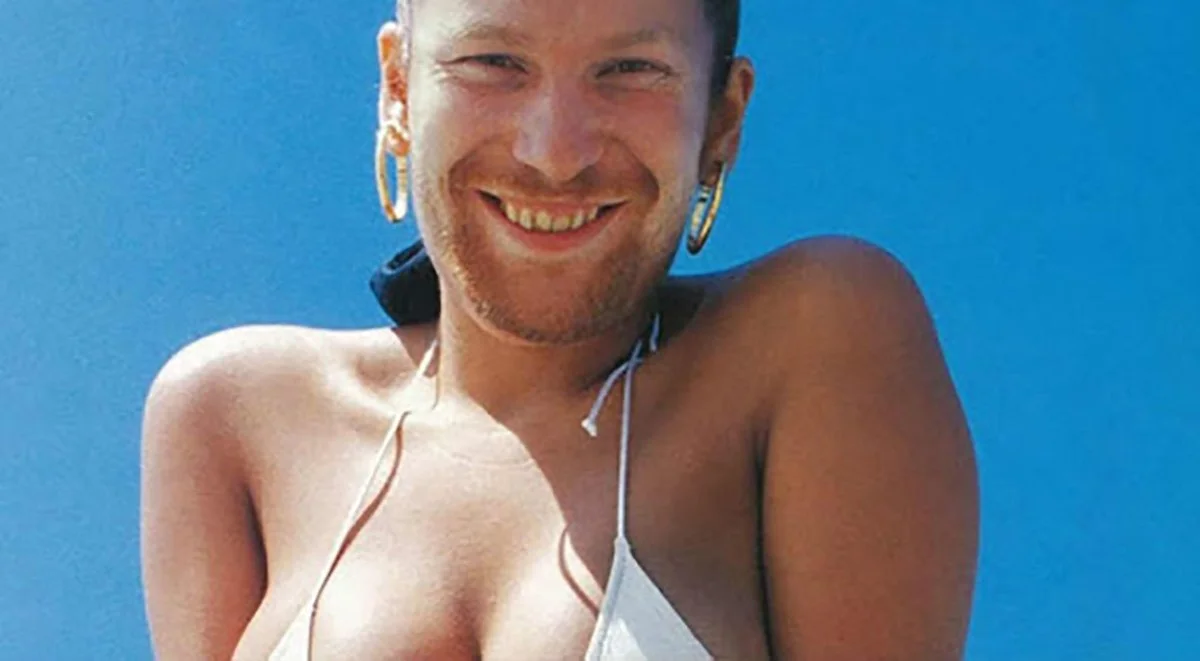
Detail from the cover image of Aphex Twin's 'Windowlicker' single

Aphex Twin (front) and his 'tank'
In their book The Sex Revolts, Simon Reynolds and Joy Press draw attention to the feminization and subsequent devaluation of popular music. Popular culture is vulgar and superficial, and 'real men' do not concern themselves with pop. Traces of this insidious belief can be found beneath IDM's claim of being an 'unpopular' alternative to dance music. IDM promises to pull both its creators and listeners out of this vulgar pop swamp. Out of the simplicity and vulgarity of the bodily, the feminine. In this sense, it can also be seen as an effort to undermine the notion: ' real men don't dance' without damaging the gravitas associated with White masculinity. However, it does this by feeding on the racial and gender advantages that they rely on.
IDM was as White and hetero as house music was Black and queer. House music emerged as a genre that powerfully sanctified the body, whereas IDM claimed to place a brain in this body it deemed empty (by the 2000s, IDM also began to be referred to as Braindance). IDM was born as a reaction to the simple formula of repetitive dance music. There is also a normative proposition behind this reaction, one that concerns race, gender and a vision for the world. It is quite possible to say, we are talking about the musical manifestation of European civilizations' inclination to separate mind and body in favour of the former. For the explicit purpose of rationalising its colonial endeavours.
In the Cartesian framework of Western civilization, where the mind is revered, and to think is to exist, the concepts of intelligence and thinking are, of course, also socially gendered. The material world related to thought, particularly education, is traditionally reserved for cis-gendered men. Intelligence has always been associated with positive sciences like mathematics, and physics, or professions like engineering and medicine, due to their association with rationalism. Ultimately, these are fields that only those with certain capital can enter. The fact that dance is about the body attracts the curiosity of White men, who examine the world outside of themselves as though dissecting a frog. But as always, they choose to intervene rather than participate. The category of electronic dance music was never enough to describe their complex new genre. Because their music is an intervention to crown an already existing but incomplete form of dance music with intelligence.
At this point, we must not forget that there is also a racial aspect in this musical intervention. We are talking about a civilization that condescends Black people by associating them with a projected proximity to nature and animalistic attributes (large penis, body odor/sweat, muscularity, etc.) It is the product of a civilisation where women are coded as simple beings who act with their bodies rather than their minds. What is necessary for regular dance music to be taken seriously is, of course, a racial and sexual correction operation.
The curious kids with glasses who shut themselves in their rooms rescue dance music from the body and deliver it to the brain, because otherwise they cannot find a place for themselves. Not because they are not invited, but because their self-perception makes them incompatible. For them, the repetition and simplicity of the music is a sign of 'deficiency.' The complex traffics and rhythms, often written by a single person alone with technical equipment and knowledge, are meant to fill this deficiency. Simplicity and ease of understanding are associated with pop music, which is considered vulgar. Music can only be embraced if it has a level of sophistication and in conjunction, masculinity (because sophistication can only be achieved in certain ways according to this understanding).
The music that turned into a way of existence, a resistance of identity proudly carrying corporeality and femininity in the hands of Black Americans, of course, loses this historical and political dimension in the hands of the White people who appropriate it. It is reborn as an undiluted exhibition of cleverness. Moreover, it even becomes a new kind of apparatus of oppression. Resistance is captured, hollowed out, and fitted to the system: the system of the White heterosexual young men.
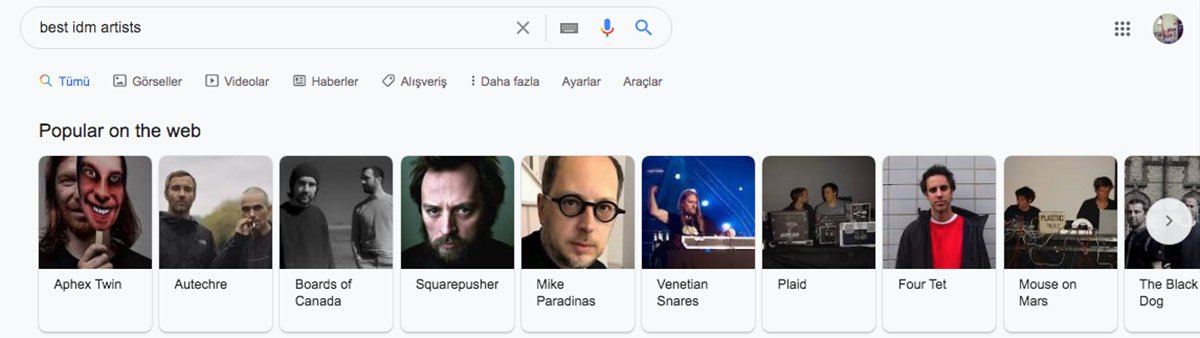
Best IDM artists, screenshot from a Google search result.
Rock music was a home for the fantasies of rebellious White men to break away from the 'domination' of their mothers and live their masculinity to the fullest. It too was detached from its Black and political roots, captured, and fitted to the system, while also fully benefiting from its cooperation with the system on issues such as misogyny and racism while rebelling against it. The rule is not broken in the case of IDM. In the changing world order, as the voices of the marginalized are heard more, and even 'listened to,' it emerges as a cry for help for the artistic reflections of heterosexual White men who are panicked by their privileges being taken away. The man who does not feel as powerful as he believes or is told he should be, finds a solution in occupying places he considers feminine. This is a colonial act, as it always carries a motivation for 'correction.'
The definition of IDM claims to bring the intelligence and order that dance culture allegedly needs. In this respect, what it represents can be seen as an antidote to the crisis of masculinity Jordan Peterson underlines. Peterson argues that order and chaos are naturally masculine and feminine. According to him and his followers the gains of movements like #MeToo and trans feminism, and new cultures that demand accountability from perpetrators are disrupting natural balance by pushing masculinity into a state of anxiety. Deprived of its privileges which it deems natural, masculinity repurposes itself by intervening through bringing order into areas it feels excluded from. I, too, think that one of the reasons for the current nostalgia for IDM, is the product of a masculine urge to deem universalise its private crisis and its fantasy of bringing order to it.
Note: Take a look at the list of the best IDM albums of all time prepared by Pitchfork, which contains very few female producers.