
Excerpt: Introduction to “Donkeys Years”
From the shop
Hey we make books!!
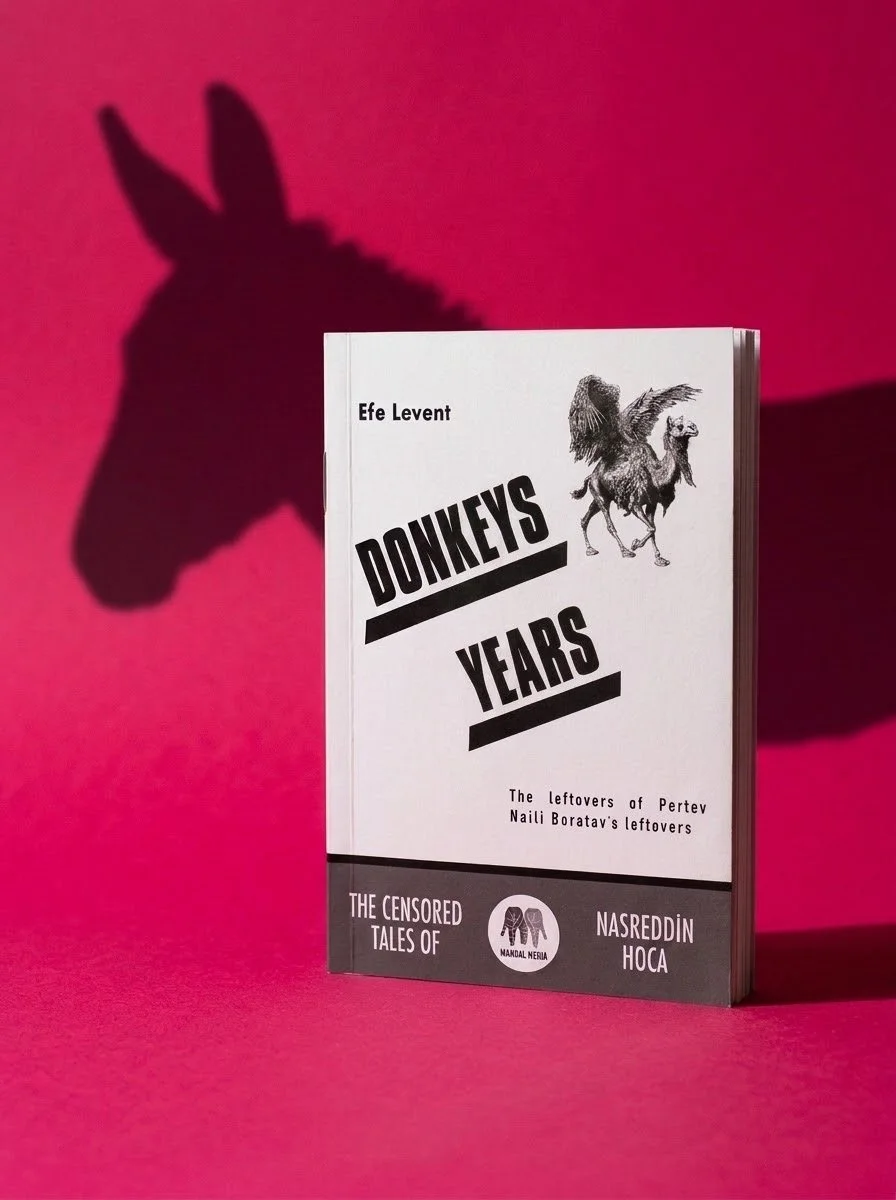
Donkeys Years is a collection of censored jokes and parables by Anatolian trickster and folk hero Nasreddin Hoca, also known as Juha in Arabic or Afanti in Chinese. Below is the introduction by Efe Levent discussing Boratav’s research to unearth lesser known jokes by the Hoca and their ongoing relevance.
Being from Turkey often implies you must have developed a sense of humour that’s capable of smirking at daily crises as if they were mere punchlines in some overarching joke. The saturation of this dark humour is perhaps the reason many roll their eyes in disinterest when I share my enthusiasm for Nasreddin Hoca and his antics. Of course, this is not helped by madcap state-sanctioned schemes intended to keep his legacy alive. Like the ill-conceived and ridiculously oversized statues that tower over roadhouses and truck stops all over Anatolia. But to me, the most tragic case is the cancellation of a ritual which involved reenacting a Hoca anecdote of pouring yoghurt into a lake. The reason for the cancellation: the drying of lakes in his hometown, Akşehir.
If you have an inclination to read local Turkish newspapers, you can follow the traces of a Cold War between the municipalities of Sivrihisar (where Hoca was born) and Akşehir (where he spent his adulthood). Petty spats over make better statues quickly escalate into threats of copyright lawsuits. Of course, I don’t blame my compatriots for rolling their eyes at these crackpot turf wars—or the Hoca himself. After all, this low stake drama between the finest busybodies of Akşehir and Sivrihisar is utterly insignificant. Especially while elected mayors are replaced by government-appointed trustees, earthquake survivors are condemned to tents, the Istanbul Convention has been abandoned, and refugees are being burned alive or lynched in broad daylight. And yet, when I saw the headline announcing that a jailed mayor’s lawyer—and then that lawyer’s lawyer—had been imprisoned, my mind couldn’t help but drift to one of Hoca’s stories. In it, Hoca catches a rabbit, only to end up cooking it for a parade of neighbours who drop by over the next three days, each angling for a bite of his bounty—until eventually, he’s left with nothing but “the leftovers of the leftovers.”
Hoca once said: "I invented eating snow with bread. But even I didn't like it."
It feels like we’re trapped in a bad dream. We’ve wandered hither and yon, crossed hill and dale—but still haven’t moved a hair’s breadth. It’s like we’ve opened our eyes halfway up a ladder with no beginning or end in sight, trying to remember whether we were climbing up or down. Every time we pause to take a breath from one burning crisis, we realize how vividly we’re still haunted by the past. We’re curled up at the core of some sordid onion, blanketed by endless layers of trouble pressing down heavy on us. And while our first instinct might be to focus on the nearest problem—only a fool would try to peel an onion from the centre.
This collection in your hands is a product of these layered troubles. The jokes you’re about to read are just a few among the hundreds collected by the folklorist Pertev Naili Boratav, who dedicated his life to scouring archives around the world. For this edition, I re-interpreted the stories into contemporary Turkish first, then to English —to add another layer of leftover flavour. I also kept the numbers he used in his book for reference. Of course, many layers of meaning had to be altered during this process. My priority has been to keep the humour of the stories alive, rather than trying to pickle-jar their precise meaning. Hence, the use of old-fashioned colloquialisms that border on quaint.
The new edition of Boratav’s collection is fairly easy to find in Turkish. However, the first edition—printed in 1995— was abruptly withdrawn and destroyed by the publisher. Before it could even hit the shelves. Naturally, the pulping of his life’s final work was far from being the first torment Boratav faced. In 1948, he was ousted from his position on charges of promoting communism and forced into exile. The newly established Department of Folk Literature he had founded at the Ankara University, was nipped in the bud a year after its inception. Back in 1936, during his scholarship in Germany to study ancient Near Eastern languages, he was deported back to Turkey for arguing against National Socialism. Even earlier, in 1932, he was summarily banished to Konya by the then Minister of Education, Reşit Galip, for standing by his professor Zeki Velidi Togan—who criticised the official Turkish History Thesis at the first National History Congress. In short, Boratav got his share of our troubled onion by getting harassed, exiled, and hounded from one end of the world to the other throughout his long and eventful life.
The official accusation against Boratav during his 1948 trial was that he focused on rebellious bards like Köroğlu, instead of those who framed folk literature in terms of “national feeling and heroism.” Boratav deliberately prioritised fairy tales, jokes, and oral traditions that lay outside the official historical narrative. In them, he tried to explore how common people made sense of the world, instead of rulers. With his erasure, our relationship to historic figures like Nasreddin Hoca and Köroğlu— who dwell on the outermost layers of our troubled onion, has been flattened into oblivion.
Perhaps Nasreddin Hoca’s greatest suffering is that he has been sentenced to life in the chasm between those who wish to enshrine him as a guardian of tradition and those who would discard all tradition without batting an eyelid. Widely believed to have lived in 13th-century Sivrihisar and Akşehir, Nasreddin Hoca emerged from a time wrecked by Seljuk succession struggles, the Mongol incursions, the Babai Revolt, and a long-lasting plague. The nationalists cling to this period as the crystallisation of a pure, undiluted Sunni, Turkish identity. That’s why our history books still spin tall yarns about Osman Gazi receiving a prophetic dream one night and founding an eponymous nation-state after breakfast. In truth, 13th-century Anatolia was a space where heterodox religious interpretations like Bektashism, Melamism, and Kalenderism were pragmatically absorbed into state traditions. Boratav’s collected jokes were deemed unsuitable and destroyed precisely because they disrupted such convenient narratives of a purified Turkish identity and statehood.
One day during his sermon, Hoca declared: “Muslims! Be grateful that god did not place your butt on your forehead. For if your butt had been on your forehead, you’d be shitting on your face every day.”
Those who claim that folk literature is only valuable when it glorifies national values strip Nasreddin Hoca of his historical context. They reimagine him as a flag-bearer for a nation they wish had always been made up of a single race and religion. Yet in stark contrast to this solemn image, Nasreddin Hoca’s name first appears in writing in 1480 in the Saltukname—as a trickster cracking raunchy jokes. The exile of Boratav played right into the hands of those who want to flatten and sanitise Hoca into a mouthpiece for authority. But just as worrying is the complete surrender of his legacy into the hands of nationalist narratives without resistance.
So okay, “we get the historical significance,” you might say. “But are the jokes actually funny?” This is a watered-down collection, with a strong flavour of “leftovers leftovers.” I tried to showcase not just Hoca’s heterodox theological and political satire, but also aimed to make them genuinely humorous. Almost all the original jokes have a kind of tantalising itch to them. They come with a lingering doubt that we’re only halfway to the punchline, long after the joke is over. It’s like tuning into a radio signal limping over from far away, distorted and difficult to make out. For me, what makes Nasreddin Hoca so compelling today is exactly that: the winding paths his voice travels before reaching me, the windy valleys and courthouse hallways it echoes through.
Support us
Keep the mangal burning
Mangal Media is supported entirely by reader donations. Visit our Patreon to see our supporter rewards and make a monthly pledge.
Join us on Patreon
We write, we print, we send
New articles and books from Mangal Media, straight to your inbox. Follow us on Substack!
Sign up now